Managing Default Risk
Jun 15
“The essence of investment management is the management of risks, not the management of returns.” — Benjamin Graham
RociFi’s credit risk management is a holistic approach designed to maximize the protocol’s margin of safety, i.e. minimize loan defaults while still being able to offer loans to as many types of borrowers as possible. The goal is to keep defaults to small, manageable amounts so as to learn from them rather than becoming catastrophic.
The three main risks analyzed during the credit scoring process are
Credit risk — the borrower is able to repay the loan, i.e. creditworthiness
Fraud risk — the borrower is willing to repay the loan, i.e. trustworthiness
Reputation risk — the borrower has something to lose in the event of failing to repay the loan, i.e. social recourse
RociFi’s credit risk is managed through a combination of rate strategy and default risk modeling. We do this three ways, through our “Volatility Charge” as a rate adder, our “Risk Premium” as a market based adjustment based on utilization, and our NFCS.
Rate Strategy
RociFi’s rate strategy is the sum of 3 parts
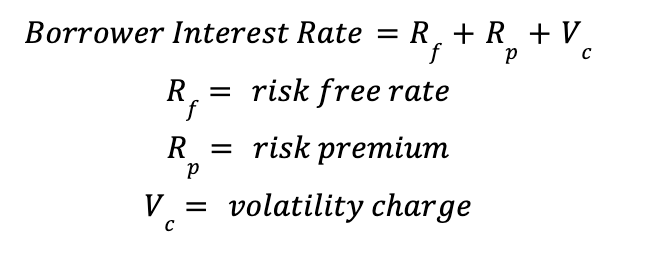
The risk free rate is simply a rate of return for lent out capital that can be earned relatively free of risk. RociFi’s proxy of this in the DeFi space is AAVE’s deposit APY offered on USDC.
The Volatility Charge is a method to assess to the borrower the cost to insure lenders against “Walkaway Risk”. To better understand Walkaway risk, imagine you are in the following situation. You currently have 1 ETH and wish to borrow against the value of this 1 ETH, say 1 ETH worth of USDC. You come to RociFi, post 1 ETH worth of collateral, and in return receive 1 ETH worth of USDC. Shortly after obtaining this loan, there is a market crash that causes your ETH to be worth half as much as it used to be. In order to regain your 1 ETH back, you now effectively have to pay 2 ETH worth of USDC at current market prices. Given this predicament, if you believe that it will be a long time before the value of your ETH will recover, and if you believe that there are limited opportunities to reinvest money you borrowed from RociFi, then it is rational for you to walk away from your loan. Thus, we call it “Walkaway Risk” because quite literally it’s the risk of walking away from that loan.
The vol charge simply produces a cost to hedge as a function of that assumed probability of default. This is added to the risk free rate, in order to solve for the base rate. Below is an example of this in action
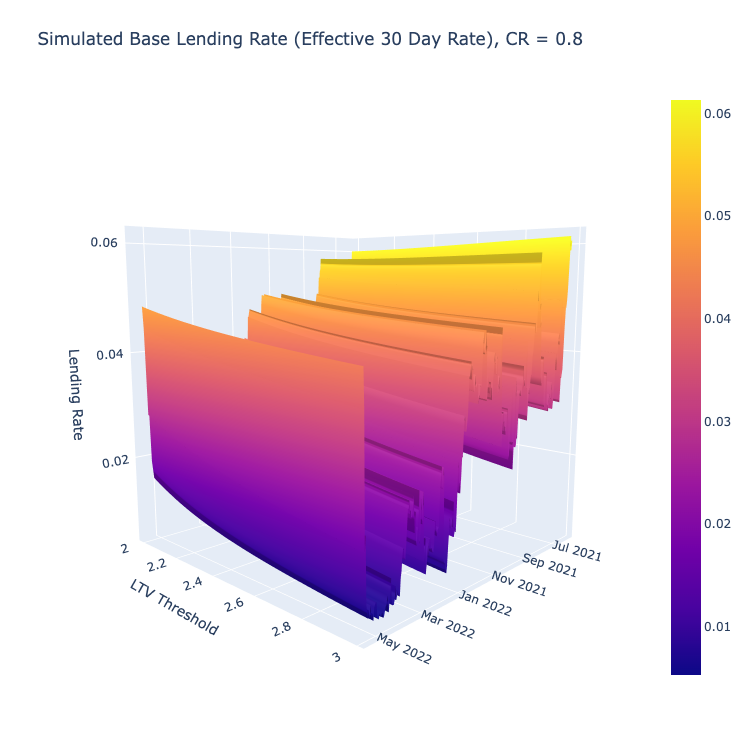
Once the base rate is determined, the next step is to determine and add the Risk Premium. This is simply a spread (positive or negative) added to the base rate in order to keep rates in line with the market desired rate of return.
One can imagine that if a large portion of the potential market for RociFi loans were given an opportunity to vote on what the right interest rate is for a given level of risk and required collateral, that this vote might result in an interest rate that differs from the base interest rate that RociFi offers. RociFi believes that this view on the correct interest rate will be reflected in the relative supply of lender capital and demand for loans, utilization rates. If rates are too low, we would expect very little lender capital, and very eager borrowers resulting in almost complete utilization. Alternatively, if rates are too high, we expect that there will be an abundance of lenders willing to lend, but very little borrows on the platform resulting in low utilization. Keeping this idea in mind, we can create an adjustment as follows
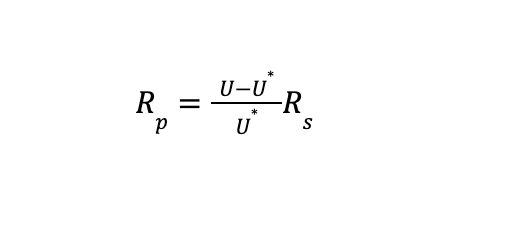
Here the variable U*simply represents some ideal level of utilization between 0 to 100%. As we deviate from that level, we simply adjust up or down. The amount by which we do that is determined by R*. Readers may notice that this is similar to the approach used by AAVE, with the distinction that the adjustment can go negative. We believe that AAVE’s approach to adjusting rates based on utilization is reasonable, and have chosen this approach for our initial rate strategy sometime post launch. Below we can see an example of what our final rate would look like if
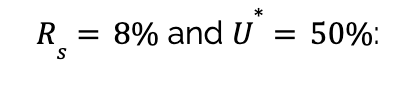
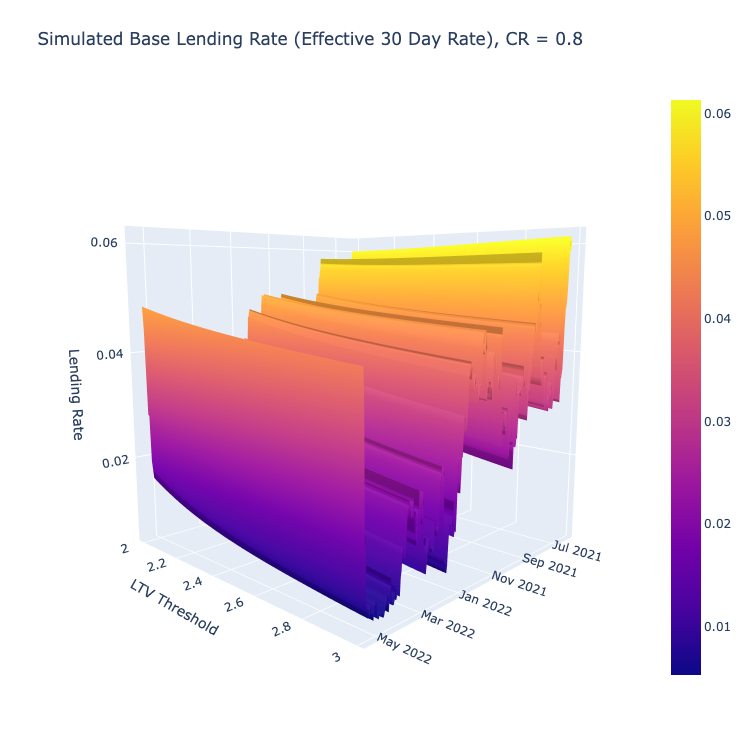
At launch however, we will not be using the dynamic approach, but rather implementing a fixed spread. This is done in order to better understand the relationship between the fixed spread and utilization on our platform, and this data will then be later used to fit our dynamic model.
Managing Default Risk
At the core of how RociFi manages default risk is RociFi’s NFCs. The NFCs takes into account a DeFi user’s behavior across other DeFi protocols, and uses this data to estimate how likely they are to default if given a loan. This probability is made into a ranking that scales from 1–10.
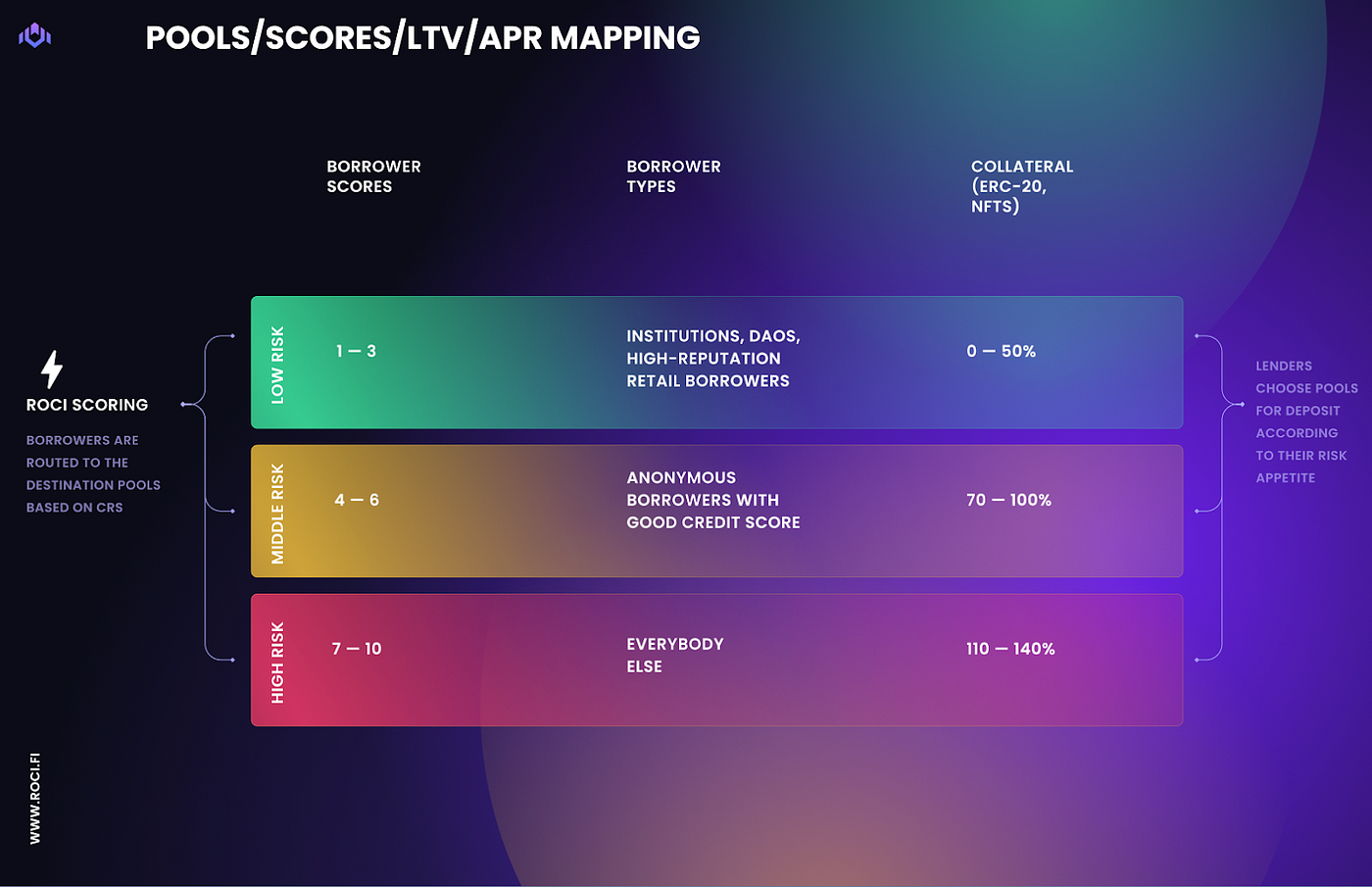
Scores of 1–3 represent the lowest level of risk. Typically speaking these will be large institutions, certain DAOs, and High-Reputation retail borrowers.
Scores 4–6 represent middle risk. These are anonymous borrowers whose DeFi history indicates that they should have a good credit score. These borrowers likely have few to no defaults shown in their borrowing history among other protocols, and have extensive history of interactions with the broader ecosystem.
Finally we have scores 7–10 which represent the highest level of risk. These are borrowers whose history likely shows some prior defaults, or perhaps this borrower has very little to no DeFi history. These borrowers will not be given access to under-collateralized lending at launch. They will instead be given over-collateralized loans at above-market LTVs as a way to build their credit and reputation within the RociFi ecosystem.
Fraud is a matter of great concern to RociFi. We have invested substantial time and resources into developing state-of-the-art AI-driven models that provide insights into whether a particular address is affiliated with fraudulent activities such as exploits, scams, phishing and more. RociFi has invested in developing two methods of identifying Fraud associated to a specific wallet address or among multiple addresses — transactional model and network model. Having two different AI-driven models with different features provides greater coverage across the multiple aspects of fraudulent transactions behavior.
Network Model
RociFi has developed a powerful network graph to spot fraudulent actors in the ecosystem via their interactions and behaviors across the blockchain. To better illustrate, we can consider the graphic below
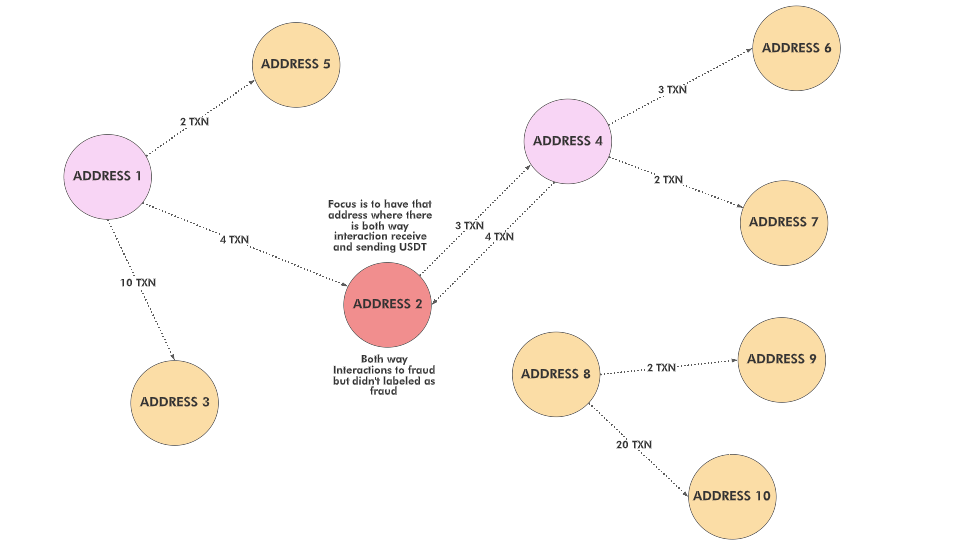
Figure 4 demonstrates how we attempt to identify fraud in our network graph. Here the red node “Address 2” represents a fraudulent address. We see that Address 1 has sent 4 TXNs to “Address 2” and Address 4 has sent 4 TXNs to “Address 2”, while “Address 2” has sent 3 TXNs to Address 4.
Based on the interactions that “Address 2” has had with its neighbors (1 and 4) and those neighbors interactions with their neighbors, using data from these transactions it allows us to extract a set of implicit features that with the help of cutting-edge Machine Learning models, is converted to a probability score that “Address 2” is fraudulent in nature, along with addresses 1 & 4. These probabilities are then rescaled to a Fraud Score, which we introduced on a rating scale of 1–10 to identify the severity of fraud (less riskier to moderate and moderate-to-high riskier). Similar to our credit score, a score of “1” represents the lowest risk of being Fraud and a score of 10 represents the highest probability of being fraud.
The set of features has been generated for multiple addresses along with their counterparties’ exposure at the closest neighboring addresses (supports up to 1-hop in real-time scanning across all the neighbors and recurrently expands up to 5th-hop which is stored in-house). We leverage these features by developing a multi-aspect network feature-driven machine learning model (which refers to network model) that automates the process of identifying a certain wallet address whether it is a part of fraudulent activity or not.
Our developed network model is benchmarked on well-known publicly available transaction explorers (contains wallet addresses and their metadata) such as Etherscan, Polygonscan, and Cryptoscamdb, to name a few. Our model outputs a fraud score corresponding to the inputted wallet address, and it can output a series of fraud scores provided if the given input contains multiple wallet addresses.
Transactional Model
The transactional model for fraud risk assesses an address’s transaction history relative to other known fraudulent actors in order to flag a given wallet address. With the help of machine learning, the transaction history along with their metadata is converted into a probability of being fraudulent and that probability can be rescaled into a fraud score on a rating scale of 1 to 10.
The transaction-level model is preferred when a given address is unknown to the fraud DB. This approach has comparative performance in terms of robustness and generalizability as opposed to network model (also known as graph-based method). However, both models have their own coverage across addresses that spans different interaction behavior. For example, in Figure 4, if all of the addresses considered were without any linkage or interconnection, then our transactional model comes to rescue.
FraudDB
Synthesizing and accumulating transactions at large scale is always an ever growing task to maintain either on cloud or on-premise server. However, a standardization during synthesization of wallet addresses minimizes the scaling problem.
We present FraudDB that contains wallet addresses which are fraudulent in nature. We assess the fraudulent behavior of wallet addresses based on the aforementioned network and transactional models. Both network and transaction-level models output a set of fraud addresses with corresponding fraud scores (ranges from 1 to 10). Most of the assessed fraud addresses have similar fraud scores in both network and transaction-level models, however, a certain set of addresses disagree among the fraud scores produced from each model. For example, our network model rates a fraud score of 9 and our transactional model assigns a fraud score of 2.
For such wallet addresses with varying fraud scores, we perform ablation analysis (similar to relevance judgment approach) on such addresses that interact with publicly available transaction explorers (such as Etherscan, Polygonscan etc.) in order to trace each address linkage, assigned labels (“Phishing”, “Stolen” and so on) etc. This post analysis as part of an ablation test is to spot and assign optimal fraud score to a fraudulent address which has two different assessments from the lens of our AI-driven methods. These post assessed fraud addresses are then fed to our FraudDB in order to strengthen the coverage of our fraud addresses database.
The combination of network model and transaction model, and FraudDB helps to reduce the odds that a fraudulent actor is permitted access to the RociFi Ecosystem. However understanding Fraud and Credit risk, while on its own may perform well enough to manage Default risk, it remains complimentary to a reputation-based social recourse system.
According to an IMF Working Paper, co-op style banking such as credit unions that are based on some “common bond” between savers and borrowers typically “yield economic benefits by increasing information about borrowers…promotes cooperative behavior…reducing adverse selection problems.”
The magic behind the above is that “credit unions have a number of clear objectives enshrined in their constitution…members must be encouraged to save as well as borrow…providing credit and loan products with fair and reasonable interest rates… efficient use and control of members’ savings for mutual benefit.”
The co-op banking example is a form of reputation risk, i.e. social recourse, used to incentivize mutually beneficial behavior by both borrowers and lenders.
This approach has historically made these institutions safer given “most credit unions did not suffer major losses in the recent global financial crisis… and cooperative banks have been gaining market share, in part because they are regarded as more risk averse, and more transparent.”
Current data from S&P Global continues to support this notion with credit unions far outperforming commercial banks in terms of loan quality.
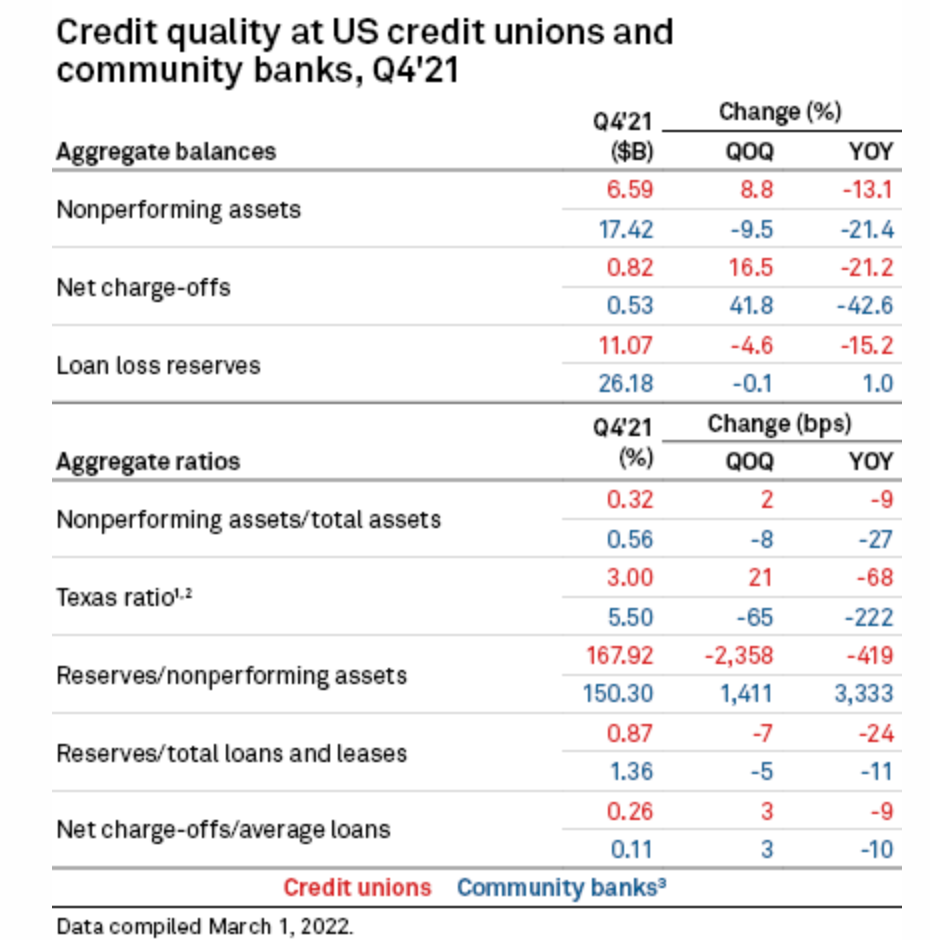
RociFi lending pools operate as the co-op bank and NFCS as reputation risk, thus incentivizing cooperative behavior while disincentivizing negatives like loan defaults.
The Process
If eligible for an under-collateralized loan, the borrower must agree to the terms and conditions that include exposure of their provided on-chain information in event of default.
Upon non-repayment, RociFi will disseminate the defaulter’s information across social media and community channels with the broader RociFi community also incentivized to share across their network channels. The goal is to create a firewall and remove bad actors from the RociFi ecosystem via on-chain reputation-based recourse. Defaulters will be banned from RociFi until the loan is repaid.
To begin, it will be mandatory for under-collateralized borrowers to have their NFCS score published on CyberConnect. This way, borrowers’ credit score and repayment history become a verified data point on their public on-chain identity.
The core thesis driving social recourse
Do you believe your on-chain identity and reputation will be more or less valuable in 5 years?
By combining Rate Strategy represented by the Volatility Charge and Market Risk Premium, Credit Scoring mechanism represented by the NFCS, and Reputation Risk measures by social recourse, RociFi believes that default risk posed by under-collateralized loans can be effectively managed.
Of course these measures are not perfect, and over time as RociFi collects more data, we will be able to improve the quality of our offering.
Ultimately post-launch, the performance of RociFi loans out-of-sample will be the best performance indication of how we are managing default risk, and what can be done to further fine tune and improve our product offering.
RociFi is bringing under-collateralized credit to Web3